Scent and sound: beeswax and clay, wool strap and iron
Two collections that work on the air of a room rather than on its surfaces. The candles and lavender are bought for their smell and their light; the whistles and bells for the noise they make. Here is how each is made, and how to get the best from it.
Rolled sheet and dipped taper
All our candles are pure beeswax with a cotton wick. They come in two families, and you can tell them apart at a glance.
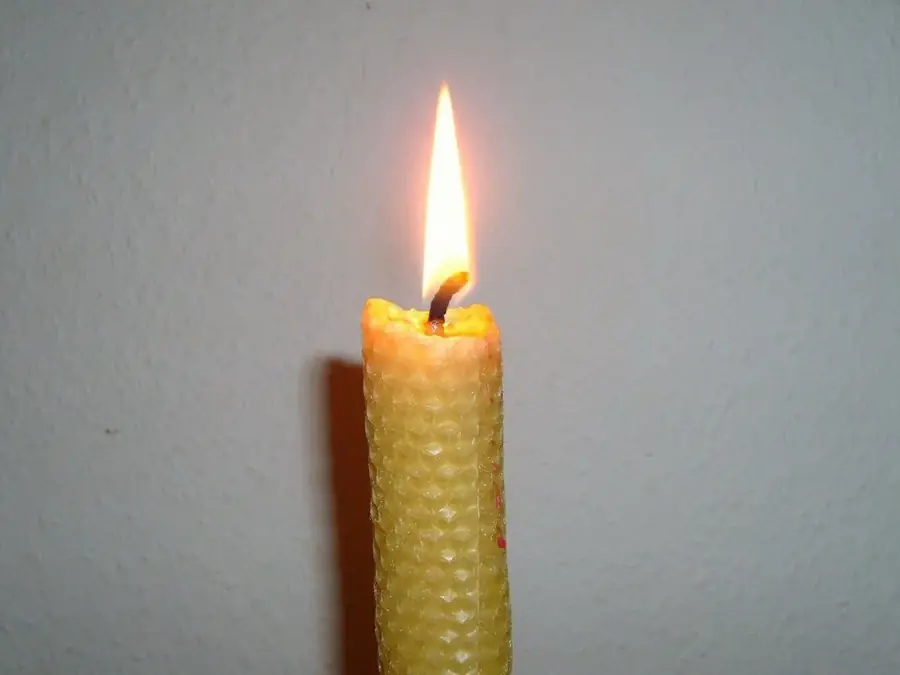
Rolled candles start as a thin sheet of beeswax pressed with a honeycomb pattern. The sheet is warmed until it is supple, a wick is laid along one edge and the sheet is rolled tightly around it. The honeycomb stays on the outside, and the candle smells strongly of the hive because the sheet has so much surface. They burn a little faster than a solid candle of the same size.
Dipped tapers are made the slow way: a length of wick is lowered into a pot of melted wax, lifted out to cool, and lowered again, dozens of times, each dip adding a skin of wax until the taper reaches its thickness. They are sold in pairs joined by their wick, smooth and tapered towards the top, and they fit a standard candlestick.
Why beeswax burns differently
Beeswax melts at a higher temperature than paraffin wax, so a beeswax candle softens less in a warm room, holds its shape in summer, and keeps its melted pool inside the rim rather than letting it run. The flame is a warm gold and steady in still air. Over time a beeswax candle may grow a pale bloom on its surface; that is natural and rubs off with a soft cloth.
Trimming the wick and burning well
Before every lighting, trim the wick to about the width of a fingernail. A long wick smokes, flickers and pulls too much wax up at once, which is when even a beeswax candle starts to drip. Let a pillar candle burn long enough the first time for the melted pool to reach nearly to the edge, so it does not tunnel down the middle. Keep candles out of draughts, away from curtains and shelves, in a holder that will not tip, and never leave one burning in an empty room.
We make no claim for the candles beyond light and scent. They are not sold for any effect on health, sleep or mood, and we would ask you not to buy them for that.
Dried lavender bundles
The lavender is cut in high summer when most of the flowers on each stem have opened, tied in bunches and hung upside down in a dry, shaded loft until the stems are brittle. We tie the dried stems into bundles with cotton thread, sometimes with a loop for hanging.
The scent is strongest in the first months after the cut and fades slowly after that. A bundle kept in a closed drawer or linen cupboard holds its smell far longer than one left in a sunny window, where light and warm air carry it off quickly. When it fades, roll the bundle gently between your hands to crush a few flowers and wake the oil left inside them. We send each bundle wrapped in paper so loose flowers stay in the parcel and do not end up in the pottery.

Clay bird whistles
A bird whistle is a small hollow clay figure with a mouthpiece at the tail. Inside, a narrow channel directs your breath against a sharp edge cut in the body, and the air splitting on that edge sets the hollow ringing, the same way a flute works. The size of the hollow sets the pitch: small birds sing high, larger ones low.
To make it warble, pour in a little water through the tail until the belly is about a third full, then blow gently. The air bubbles through the water, and the note breaks into a rapid trill, close to birdsong. More water lowers the note and slows the trill; too much and it gurgles. Afterwards, tip out the water and let the whistle dry with its tail pointing down.
Most of our whistles are left as plain fired terracotta, some are painted with slip and glazed. They are sturdy, but they are fired clay: not for toddlers, not to be bitten, and best kept off stone floors.
We also stock small clay bells with a clay clapper hung inside on a thread. Their sound is soft and dry, more knock than ring, and they are hung in doorways and on windows.
Hand-forged sheep bells
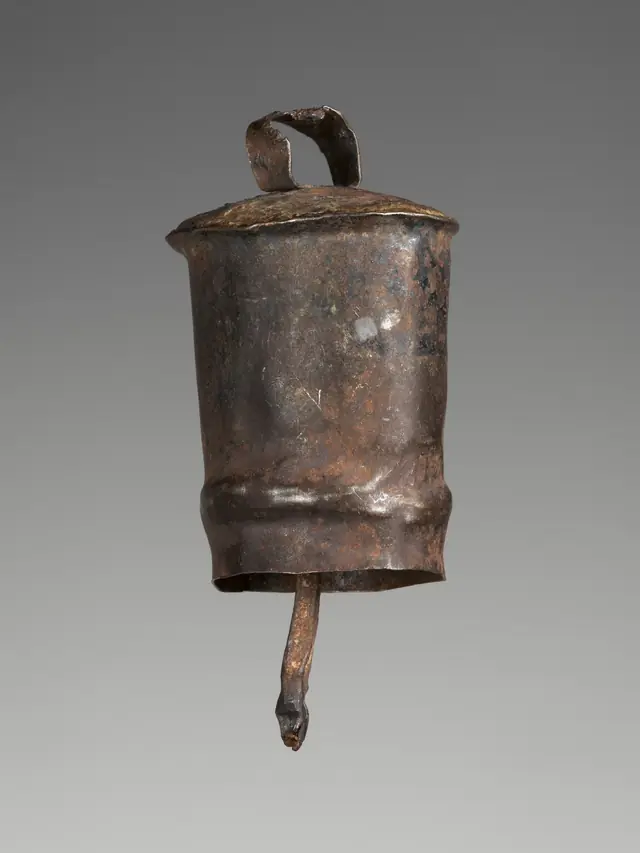
A forged sheep bell is not cast in a mould. The smith cuts a pattern from sheet iron, heats it and hammers it over a form into a hollow shape, then closes the seam by folding and riveting it. The bell is often coated in brass or copper and heated again so the coating flows into the seam, which both seals it and gives the bell its warm, dark colour. A loop is formed at the top and an iron clapper is hung inside.
What sets the note
The note of a bell comes from its size, the thickness of its walls and the flare of its mouth. A larger bell with a wide mouth sounds lower; a narrow, tall one higher and sharper. A smith can raise or lower the note a little by hammering the rim in or out after the bell is finished, and shepherds once chose bells of different notes so they could tell their flock apart by ear. Because each one is hammered by hand, no two of our bells sound exactly alike, and we are happy to describe the sound of a particular bell before you choose.
Our sheep bells hang on woven wool or leather straps with a buckle, ready for a garden gate, a porch beam or a hook by the door. Kept outdoors, the iron will weather to a deeper brown; a wipe with a little oil once a year keeps it from rusting through.