Sight and touch: pottery and weaving
The two oldest collections in the shop, and the two you notice first in any Romanian house: painted plates along a shelf and a woven runner on the floor beneath them. This page explains how both are made, what the patterns are, and how to look after them so they last.
From red clay to a painted plate
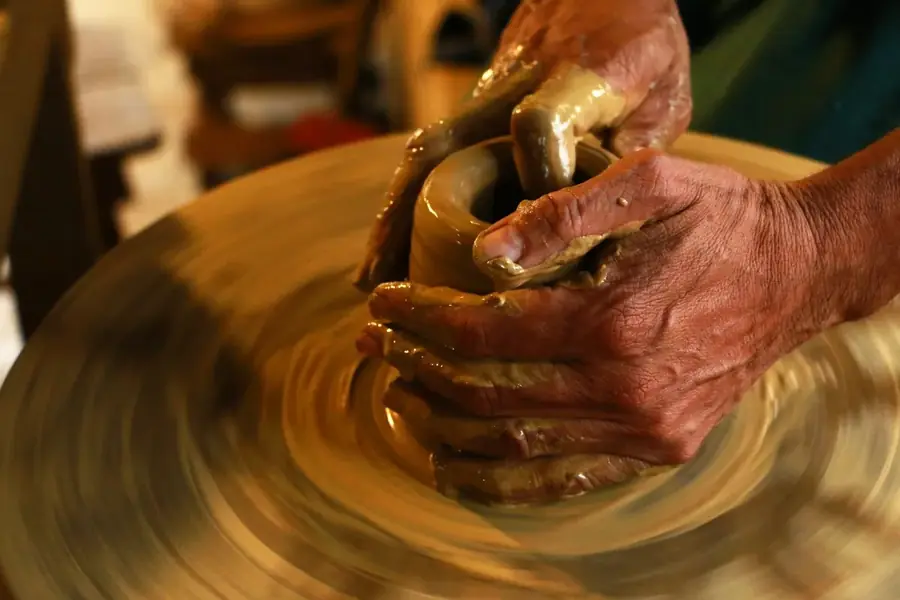
The pottery we stock starts as local red clay, thrown on a wheel or pressed over a mould, then left to dry until it is leather-hard. At that stage the potter pours or dips a coat of slip over it: liquid clay of a different colour, often a cream engobe that turns the red body into a pale ground for painting. Darker slips in brown, green, ochre and blue are then trailed on with a cow horn fitted with a quill or a thin tube, so the line flows like ink from a pen.
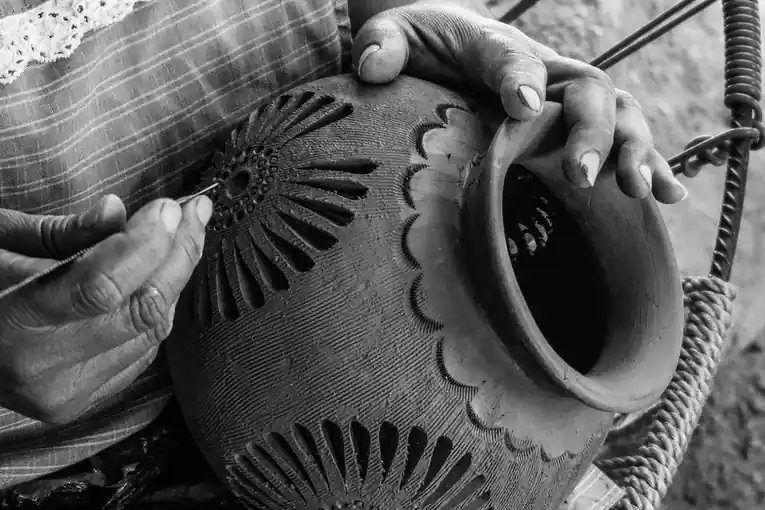
The horn is what gives the work its look. A line drawn with it starts thin, thickens where the hand slows and tapers as it lifts, which is why the spirals look as if they are turning. Dots are dropped from the same horn, and some workshops comb the wet slip with a feather to marble it. None of the decoration is scratched through; it all sits on the surface, under the glaze.
After a first firing in the kiln the piece is dipped in glaze and fired again. The glaze melts into a glassy skin that seals the clay and brightens every colour beneath it. Where it runs thick, at the foot of a bowl or the lip of a jug, it pools darker; where the kiln was hotter, a green can turn almost black. That is the difference you see between two plates of the same pattern.
The motifs that come back again and again
Village tableware repeats a small vocabulary of signs, and people have long read meanings into them. We pass these on as the traditional readings, not as anything a plate will do for you.
- The spiral is the commonest of all, often wound in rows around the rim; it is usually read as the turning of the seasons and the sun.
- The wheat ear stands for the harvest and for a full table, which is why it appears so often on bread plates and bowls.
- The tree of life, a central stem with branches rising from it in pairs, is read as family and continuity, and it fills the middle of large plates.
- The cockerel is the morning bird, the one that wakes the house; it is painted mid-stride with a raised tail.
- Birds in general, often a pair facing each other, are read as company and as a sign of spring.
We do not take orders for new designs or names painted on, because the potters paint the patterns they know by hand and eye, not to a drawing. What you see on the shelf is what we can offer.
Food, oven and dishwasher
Any piece we sell for the table carries a glaze its workshop fires for food use, glazed fully on the inside. Plates made to hang, and a few jugs glazed on the outside only, are for display, and our reply says so beside each one. Ask if you are unsure; we would rather answer twice than have a wall plate used for soup.
Terracotta is happiest with gentle changes of temperature. It can go into a warm oven if it goes in as the oven heats, and come out onto a wooden board or a folded cloth rather than a cold stone worktop. It does not go under a grill, onto a hob flame, or from the fridge straight into a hot oven. Small cracks in old-style pottery come from thermal shock, not from age.
We advise washing by hand. A dishwasher will not usually harm a well-fired glaze at once, but the heat and strong detergent dull the shine of painted slip over months and can chip a rim against the rack. Warm water, a soft brush and a dry tea towel keep the colours as they left the kiln.
Wool and cotton on the loom
Every textile we sell is woven on a floor loom. The warp, the long threads stretched from the back beam to the front, is set up first; the weaver then passes the weft across and back between them, beating each pick into place. How hard it is beaten decides the cloth.
Our wool runners and small rugs follow the scoarță-style weave: a weft-faced cloth in which the wool is packed down so densely that the cotton or hemp warp vanishes beneath it. Patterns are built up block by block, with diamonds, hooks and stepped lines in reds, greens, blacks and natural fleece. The result is a heavy, flat, reversible textile that lies still on a floor and wears slowly.
Cotton is woven more openly. Table runners and towels show both warp and weft, with a band of coloured pattern woven across each end like a border, and the body left plain or striped. They are light, they wash well and they soften with use.
How a border is finished
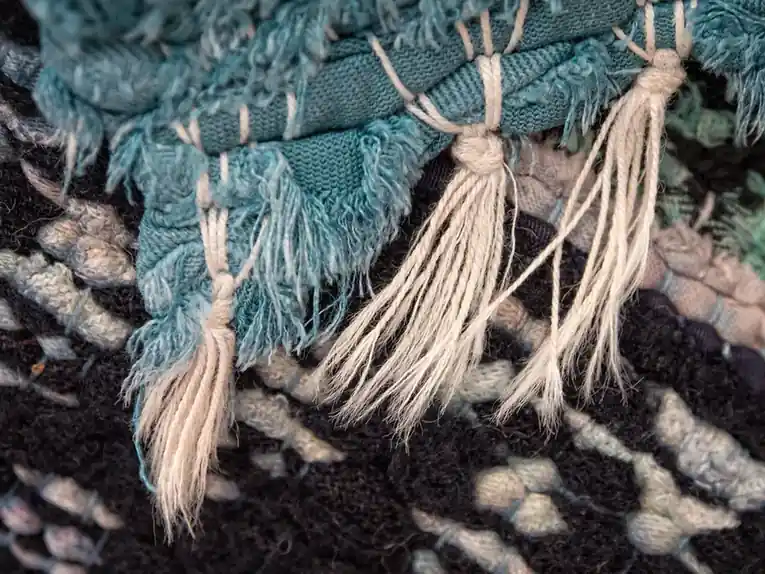
When the weaving is done, the warp is cut from the loom and the loose ends become the fringe. To stop the weft from working loose, the weaver knots the warp threads together in small groups close to the last pick, then twists or plaits the ends and trims them level. On the heavier wool pieces a narrow plain band is woven before the pattern starts, so the knots sit on a firm edge. A well-finished fringe is the first thing to check on a hand-woven piece, and we describe it in every reply.
Caring for a woven rug or runner
Wool needs less washing than people expect. Shake a rug outside, or beat it gently over a line, and turn it from time to time so it wears and fades evenly; the weave is the same on both sides. Spills are blotted at once with a dry cloth, then sponged with cool water, never rubbed. If a rug needs a full wash, use cold water and a wool soap, do not wring it, and dry it flat in the shade.
Lay a thin underlay beneath a rug on a smooth floor so it does not slide, and keep it out of strong afternoon sun, which bleaches reds faster than any other colour. Cotton runners and towels go through a gentle machine wash at a low temperature; iron them while still slightly damp and the border pattern stands up crisply.
Moths love wool that is stored dirty and left in the dark. A clean rug rolled, not folded, with a lavender bundle from our scent collection tucked inside is the old way of putting one away for summer.